
On Bob Dylan
Some thoughts on a great artist

1.
How does it feel – how does it feeeel – to listen to Bob Dylan for the first time?
There’s a line in Philip Larkin’s poem “For Sidney Bechet” that nicely describes my own initial reaction to the great man’s music: “On me your voice falls as they say love should, / Like an enormous yes.”
I was thirteen years old when that “enormous yes” first fell on me. It was the summer of 2007 and I had just come across Rolling Stone magazine’s list of “The 500 Greatest Songs of all Time”. Even back then, I found the idea of ranking hundreds of songs a bit silly. Who could possibly make the claim, with a straight face, that “Ruby Tuesday” is the three hundred and third greatest song ever made? Or that “Blitzkrieg Bop” is “four songs better” than “Blue Suede Shoes”? But aesthetic hierarchies of this sort hold a certain charisma over the hungry teenage mind – not because of what ranks three hundred and third, but because of what ranks first.
And according to this list, the number one song ever written was Bob Dylan’s “Like a Rolling Stone.” Without further delay – and paying no heed to the curious overlap between song and magazine title – I downloaded this apparently superlative single off Limewire on the family PC and listened to it on my iPod Shuffle (ah, 2007!)
Right from that opening snare shot (which sounded, as Bruce Springsteen said, “like somebody'd kicked open the door to your mind”), I was transported to the world of Bob Dylan, and I’ve been living there ever since. I must have heard the song before, in supermarkets and restaurants, on Classic Rock radio, but until then I’d never listened to it – actively, with all my senses open.
People say Dylan can’t sing. But I was instantly hypnotised by that “cawing, derisive voice” (Larkin again), and by the energy and attitude of the arrangement. Above all, by the sophistication of the lyrics, with all those strange, alluring images and characters (“mystery tramp”, “Siamese cat”, “Napoleon in rags”). The song was intelligent as well as soulful, and seemed to engage the entire cortex even as it made your head bop. I took another trip to Limewire, and downloaded every Dylan song I could find. This turned out to be quite a few.
2.
So Bob entered my life, and an obsession began. I have fond memories of haunting the likes of HMV and Golden Discs and Tower Records, as well as murky record shops down inner-city sideroads, looking for any Dylan CD I could find. I followed the well-worn trajectory of the obsessive, i.e. from the well-known to the obscure: the universally beloved classics, then the fan favourites, then the mediocre ones, the downright weird ones (“Wiggle Wiggle,” “Million Dollar Bash”), then the Live Ats and the Live Ins, the B-sides, the box sets, the Bootlegs.
It got to the unfortunate point where I wasn’t content to simply admire Bob Dylan. I started wanting to be him, too. I became slightly too interested in those surreal press conferences he gave in the mid-Sixties, where he answered every journalist’s question with a question of his own, or a bizarre evasion that always amounted to something like “you squares don’t get it, do you?”. Sitting in my bedroom, surrounded by Dylan CDs and Dylan posters, my mother would call me down for dinner – and summon me from my fantasy world. Of course, I’d roll my eyes and say: “What even is dinner, man?”
And all the time I was listening to the songs, convinced they had something unimaginably profound and important hidden in their structures. I even scrawled lines from “It’s All Over Now, Baby Blue” onto my wall. If I recall, the lines were:
The highway is for gamblers
Better use your sense
And take what you have gathered
From coincidence
Pretty good, for sure, but I couldn’t tell you now why they ignited my soul quite like they did back then.
I suppose I had that fundamentally adolescent apprehension that great artists knew things – deep, intricate things – about the nature of existence, and that these things would reveal themselves to those who paid close enough attention.
I would listen to “Visions of Johanna” and “Desolation Row” and “Sad-Eyed Lady of the Lowlands” and “Idiot Wind” and “A Hard Rain’s A-Gonna Fall” with the crazed notion in my mind that these songs, if you could only match their artistic intensity with a listener’s intensity of your own, might somehow unlock the secrets of the universe.
This was true above all for “It’s Alright Ma (I’m Only Bleeding)”. Seven minutes of steely-eyed truth-telling, interspersed by a violent, spasming guitar riff, the song probably contains the highest density of great lines in any Dylan song. “Money doesn’t talk, it swears.” “He not busy being born is busy dying.” “Even the President of the United States sometimes must have to stand naked.” “Though the rules of the road have been lodged, it’s only people’s games that you got to dodge.” And this spectacular verse:
Disillusioned words like bullets bark
As human gods aim for their mark
Make everything from toy guns that spark
To flesh-colored Christs that glow in the dark
It’s easy to see without looking too far
That not much is really sacred
Listening to this as a teenager, I couldn’t shake the impression that Dylan had gone up the mountain, out to the crossroads, down into the underworld, had consorted with God and the Devil, and returned with nothing less than the meaning of life.
I don’t believe such things any more, but I still like the song.
3.
I saw him live once, in Dublin, in what was then the O2 Arena. I was sixteen; Bob was sixty-nine, but he seemed twice that age, maybe three times that age. It wasn’t the best show. It wasn’t even a good show. I was there with my pal (named Dylan, incidentally); neither of us could tell which song was which, or where one song ended and the other began. I had lots of questions. Was that mysterious ditty, with its desert-road guitars and gypsy-wedding accordions, supposed to be All Along The Watchtower? Was that string of coughed-out gibberish supposed to be Blowin’ in the Wind? And come to think of it, was that fuzzy little man in the top hat supposed to be Bob Dylan? I half-expected a squad of flustered bouncers to tackle the singer to the ground, drag him offstage, and announce that the real Mr. Dylan would be arriving shortly.
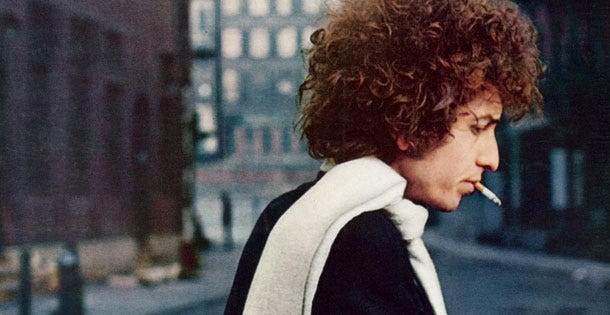
But I was so much older then… These days I appreciate, even love, late-career Dylan. He is a monument now, and he knows it, and he sings like it. As I write, I’m listening to his most recent album, 2023’s Shadow Kingdom. It’s nice. At times it’s beautiful. It’s not Highway 61 Revisited or Blonde on Blonde but then, what is? Dylan seems in all ways so different from the glamorously cerebral rock star of 1965 – the ultra-cool drugged-up kid-genius, with cigarette and Ray Bans, snarling at you from under a storm of curls – the fact that they happen to be the same person seems like a mere technicality. They say every atom in your body changes from one end of life to another; I think Dylan’s have changed several times over.
4.
When you start writing about Bob Dylan, you realise how many Bob Dylans there really are. His talent is so elusive and multiform that it would take a crack team of researchers to fully account for it. He was, for instance, a great narrative writer, with a novelist’s gift for setting, character, and detail. Take the celebrated opening of “Highway 61 Revisited”:
God said to Abraham, "Kill me a son"
Abe said, "Man, you must be puttin' me on"
God said, "No", Abe said, "What?"
God said, "You can do what you want Abe, but
The next time you see me comin' you better run"
Well Abe said, "Where do you want this killin' done?"
God said, “Out on Highway 61”
Or this verse from Tangled Up In Blue, which could be a scene in a Raymond Chandler novel:
She was working in a topless place
And I stopped in for a beer
I just kept looking at the side of her face
In the spotlight, so clear
And later on, when the crowd thinned out
I was just about to do the same
She was standing there, back of my chair
Saying, "Don’t tell me, let me guess your name."
I muttered something underneath my breath
She studied the lines on my face
I must admit, I felt a little uneasy
When she bent down to tie the laces
Of my shoe
I could also refer you to the entirety of “Hurricane”, which is basically a kind of moral drama – complete with incident, atmosphere, and memorable dialogue – in the form of a fast-moving rock and roll song.
As well as being a narrative genius and a political firebrand and a purveyor of truths about society and the self, Dylan has another mode, which is my favourite mode. He is, in the largest sense of the word, a visionary. His words often (as Martin Amis said of Vladimir Nabokov) “detach themselves from the everyday and streak off like flares in a night sky”. His great visionary songs don’t really make coherent points or tackle coherent themes (even if they seem to) but rather whirl like a tornado around an idea or phrase, accumulating beautiful, broken, perplexing images as they do.
I think his first great song in this style was “A Hard Rain’s A-Gonna Fall”. The song is replete with quasi-biblical apparitions of wandering souls in strange lands, and concludes with the following extraordinary lines:
And I’ll tell it and think it and speak it and breathe it
And reflect it from the mountain so all souls can see it
Then I’ll stand on the ocean until I start sinkin’
But I’ll know my song well before I start singin’
And it’s a hard, it’s a hard, it’s a hard, it’s a hard
It’s a hard rain’s a-gonna fall
In Martin Scorsese’s No Direction Home, Allen Ginsberg recalls breaking into tears upon hearing these lines because he knew at once that the era of the Beats was over, and something new and powerful had arrived in its place.
What are the elements of the visionary style? What fed into it? Famously, Dylan has an encyclopaedic knowledge of early- and mid-century American music. The imagery of American folk and blues – of freight trains cutting across prairies and deserts, of ramblers and gamblers and preachers and outlaws, of the empty highway and the barren wilderness – is one part of it. The other part, more scattershot, comes from Dylan’s reading of urbane Europeans and New Yorkers: Rimbaud, Verlaine, Ginsberg, Dali, Eliot, Pound. From this latter bunch, Dylan developed sophisticated insights into art and artifice, the arbitrary nature of power, the importance of the unconscious and the world of dreaming. This combination of influences, further deepened by Dylan’s own indivisible weirdness, results in a magnificently paradoxical voice: refined yet wild, precise yet amorphous, cruel yet loving, erudite yet of the earth.
Here, for example, is a verse from Dylan’s Blind Willie McTell (a flat-out masterpiece in the visionary style):
See them big plantations burning
Hear the cracking of the whips
Smell that sweet magnolia blooming
See the ghosts of slavery ships
I can hear them tribes a moaning
Hear that undertaker's bell
And I know no one can sing the blues
Like Blind Willie McTell
And then the song’s utterly perfect ending:
God is in His heaven
And we all want what's His
But power and greed and corruptible seed
Seem to be all that there is
I'm gazing out the window
Of that old Saint James Hotel
And I know no one can sing the blues
Like Blind Willie McTell
5.
At his visionary height, Dylan is a kind of boxcar shaman, a hobo-mystic, whose songs move like the night wind, like the smell of something burning, like a great, slow river of perception. He doesn’t describe or define: he evokes, conjures, distils. He casts his peculiar light without discrimination upon the here and the hereafter. And if I had to condense the nature of this talent into one word, I would choose a very apt one: electric.
Like electricity, Bob Dylan has the power to shock and illuminate, to mesmerise and hypnotise. His genius is an elusive, chaotic thing that resists channelling, but when it does flow in a single, stable current, it has the power to light up the world. Like electricity, like any elemental force, we hardly notice how much we owe him, or rely on him, and we'll miss him like hell the day he’s gone.
.